Over the last decade, there has been a tragic number of football clubs in England being liquidated. Clubs like Bury, Macclesfield Town and Chester City FC have all gone under in recent years, prompting many to question the rules regarding ownership of clubs. Many have blamed COVID-19 for some of the more recent issues, but that doesn’t wash – at least not in every case. Even more recently, Bolton Wanderers and Charlton Athletic have been just hours away from liquidation, but fortunately saw more positive outcomes than some of those before them.
So with all of these incidents involving clubs very much in living memory, why do Southend United find themselves on the brink of liquidation? Have we seriously learnt no lessons from these previous tragedies? And how can an asset as significant as a football club be allowed to be put in this position? I’m going to try to answer all of that and more as I look at Southend United’s current situation, and how Ron Martin has done little to help.
The Story So Far
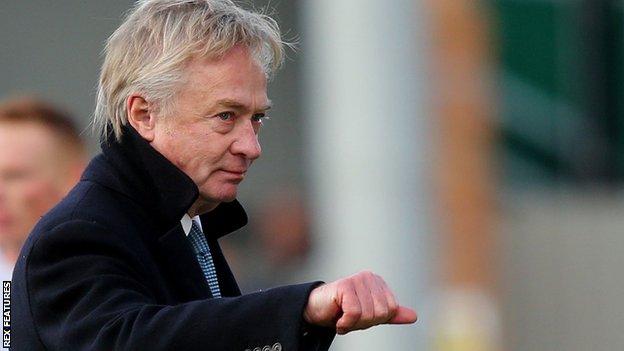
Ron Martin became the majority shareholder of Southend United in 1998 for a reported fee of around £4m – a deal which also included the club’s stadium, Roots Hall. The actual shareholding of the club itself was 55%, meaning it was only just a majority, but enough to give him control. Martin’s start to life at the Essex-based club was as you might now expect… controversial. His company, which he bought the club with, had previously purchased Roots Hall’s ‘South Bank’ and after arriving at the club Martin intended to redevelop this area and move the club to a new site in Southend. When John Main became the club’s CEO, he raised concerns about the club paying its own owners annual rent of £400k to stay at Roots Hall, questioning Martin’s motives and ability to maintain no conflict of interest. Clearly Martin wasn’t fond of this criticism and in September 2000, he forced Main out of the club as a condition of a £1.5m investment by Delancey Estates. Plans for the Shrimpers to move to a new ground didn’t materialize at this time, meaning that their stay at Roots Hall was prolonged. In the years that followed, the Shrimpers enjoyed good results, including back-to-back promotions. Around the time of their second promotion, in 2006, Martin bought out Delancey’s shareholding which gave him much more control of the club. Following this, he pushed ahead with plans for a £25m leisure development at the Fossetts Farm site in Southend, including a proposed 17,000 seater stadium for the club, though a year later he increased the capacity of the new stadium to 22,000 – which was approved by the council. Unfortunately for fans of Southend United, it wouldn’t be until 12 years later, in 2020, that firm plans for the stadium emerged – but there were plenty of highs and lows before then.
The club’s financial issues initially came to a head during the 2009/10 season, when the club faced 2 winding-up orders by HMRC relating to unpaid taxes. Their struggles worsened in 2010 when the club’s players went unpaid, forcing the Professional Footballers’ Association (PFA) to cover them. As such, the club was placed under a transfer embargo until the PFA were reimbursed. Eventually, in April 2010, their outstanding debts of approximately £338,000 were paid off – thanks to a drastic decision made by Ron Martin. He remortgaged his £1.6m Benfleet home to free up £750,000 to pay the aforementioned debt and guide the club clear of possible administration. This ‘bailout’ by Martin is just a small sum compared to the £13.5m he had previously pumped into the club since 1999. From here, the club’s issues have spiralled to an unimaginable scale – including issues with wages and general debts. This led to a number of lawsuits against the club and Ron Martin which started to really add up. The club’s issues came to a head in 2020 when they were placed under an EFL transfer embargo due to unpaid taxes and wage-related issues. These issues culminated with the club being relegated out of League One, ending their 5-year stay in the division. Many consider the COVID-19 pandemic, which largely impacted the following season, 2020-21, saw the club forced to furlough several staff and players. While they weren’t the only club to do so, they were criticised by the PFA, who cited their past failures to pay player wages and saw this as an excuse to continue doing so. The uncertainty and off-the-pitch issues led to struggles on the pitch and, come the end of the season, the Shrimpers suffered their second successive relegation – seeing them fall out of the Football League for the first time in over a century.
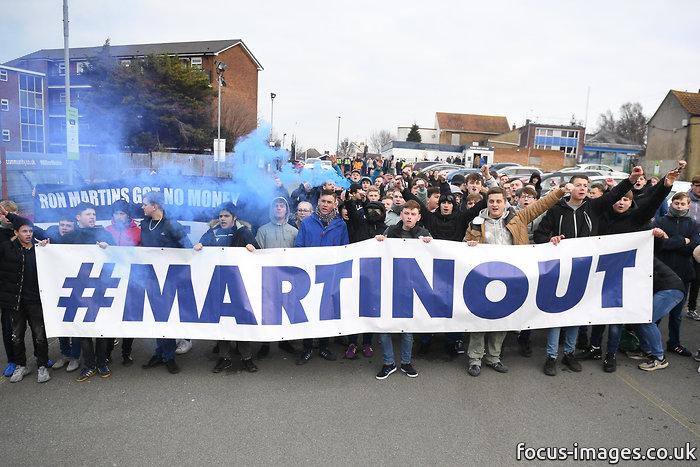
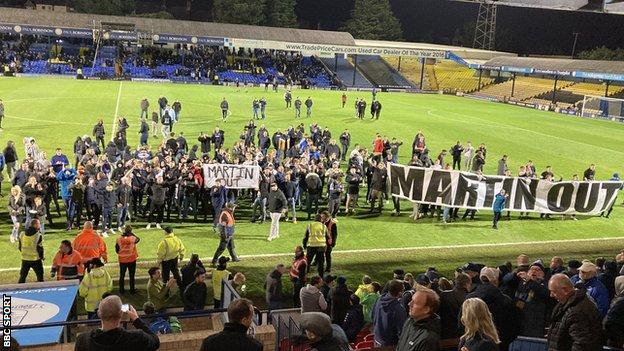
At this point, now as members of the Vanarama National League, protests against Ron Martin’s continued ownership of the club reached new heights. Fans were clearly fearing not just the future of football at Roots Hall, but for the very existence of the club itself. Despite these fierce protests, Martin dismissed the idea of selling the club and insisted “the future will be great again (for the club)”. He was also very critical of the club’s relegation from League Two, citing the fact that relegation in the division below had been suspended due to the pandemic. This brings us to roughly the present day, where the club’s issues are far from over, and their prospects are seeming bleaker by the day, if not hour.
The Situation Now
The club revealed in August 2021 that they had amassed a staggering £17.4m worth of debt. Martin openly admitted that most of the debt was owed to his own companies – raising further questions surrounding his intentions. He did also, however, reveal that £6.8m worth of debt had been written off, which put the club in a slightly better position – though that isn’t saying much. He has finally, reluctantly, agreed to sell the club but in the months that have followed, they have spent numerous days in court as HMRC have bought a new winding-up order against the club – though this has been pushed back several times and is currently awaiting a new hearing, on August 23rd. This latest extension, which is widely expected to be final (though Southend fans have heard that before), allows time for a sale of the club to be completed – which doesn’t leave long to find a buyer, and to complete the takeover process.
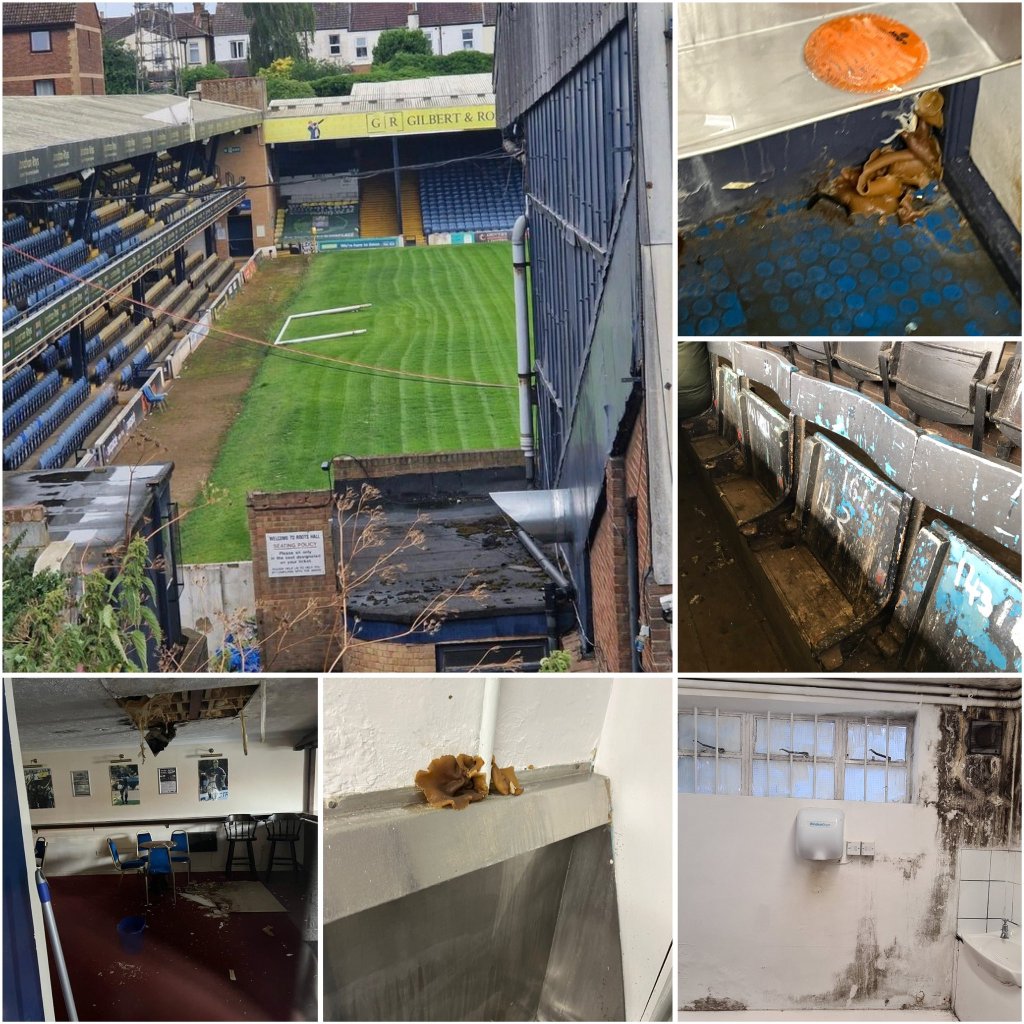
We are just 12 days away from Southend United’s first scheduled home game but as you can see by these photos (taken in the last week or so), the stadium looks abandoned and completely unprepared to host football matches and fans. In fact, it has got to a point where fans have been volunteering to clean and prepare the ground as the new season creeps ever closer. One thing is sure, this doesn’t look like the stadium of a club whose owner cares. The situation is so bad that fans, and the club, are awaiting a final decision from the National League as to whether or not their membership will be revoked due to uncertainty over their future and ability to fulfil their commitments to the league this season. Thankfully for the Blues, their chances of retaining their league status, for the time being at least, look very high – having just been given permission to pay a debt that was seen as crucial to the decision – though it will still prove to be a nervous wait.
I reached out to Ron Martin to pose some questions regarding the current situation, and his commitment to the club. I got a swift reply, but not from Ron. I was informed by a club secretary, Lisa Basgallop, that Ron hasn’t been involved in the day-to-day running of the club since the pandemic – and apparently doesn’t check his own emails. I was told that these duties are being undertaken by the club’s CEO, Tom Lawrence, in his supposed absence. She was, however, able to answer one of my questions by saying “Ron is fully committed to the club’s sale & future”. This sounds promising but is the same line that the club have churned out for months – so it doesn’t mean much. There are rumoured to be several interested parties looking at a takeover of the club, but time is running out and there has been very little movement of late.
Lisa Basgallop
I became intrigued by the person who responded to my email on behalf of Ron Martin. Her email had a Southend United club footer, which clearly stated she was the club secretary. Despite this, she isn’t listed on the club official’s page on Southend United’s website. I was also unable to find any reference to her online, besides 2 vacancy posts on the club website which merely cite her email address. Not only this, but I couldn’t find a Linkedin profile, or any social media for that matter, under this name which makes me beg the question – does she exist at all?
I’m honestly not sure what the point or benefit of creating a fictional secretary could be but, given the current running (or lack thereof) of the club – it wouldn’t surprise me. If nothing else, the fact that a club official is missed from the list on the club’s website surmises the mess that has been caused by the hierarchy.
My Views
I’ve had a real soft spot for Southend United since my Grandad moved to the area. He would regularly attend games with my uncle, who suffered from Alzheimer’s, and it was a real point of joy for them both. The club undoubtedly brings the same joy and escape for thousands of fans, and is truly at the heart of the community. It not just saddens, but angers me that a football club can be run into the ground by a clearly inept owner – and footballing bodies and the government are powerless, or unwilling to do anything about it until it comes time to sanction these clubs.
From a footballing perspective, I think that this situation, coupled with previous examples, shows that the fit and proper owners tests in each division are not fit for purpose and need a revamp to protect clubs, and the footballing pyramid’s integrity.
I don’t know what the future holds for Southend United, but I truly hope that they not only survive, but are able to thrive under new ownership and promptly return to the football league – where they belong. But the fact remains that the longer that this goes on, with the club severely lacking players, relegation next season looks a real threat, even if they survive as a club.
One thing is for sure: football clubs are not businesses, and football fans are not customers.
#MartinOut
 Jak Netting
Leave a comment